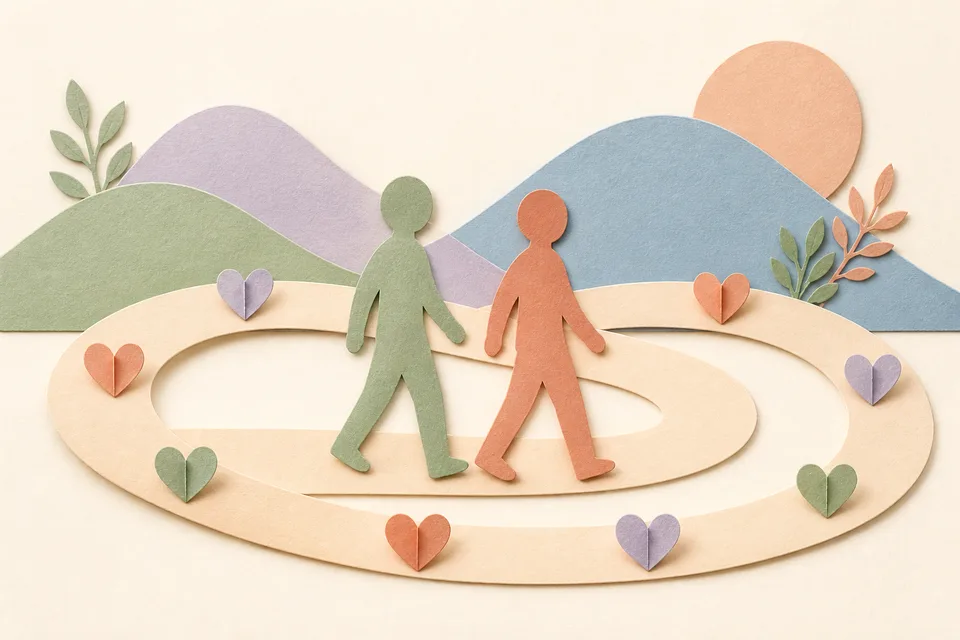
I Keep Repeating the Same Pattern When I Date
If the person is different every time but things fall apart at around the same point for similar reasons, it's more likely a current your own temperament creates than bad luck. Here's why the early-dating you differs from the you a few months in, how attraction and breakups grow from the same root, and concrete ways to break the cycle.
The “you” in this story, is it really you? See my Social & Private self · free →
When your third relationship ended, a friend said carefully, “But don't you always do this at around three months?” At first you bristled, but when you got home and thought it over, they weren't wrong. It always started out exciting and fast. Then, at around three months, the other person would say, “You've changed a bit since the beginning,” and that stung, so you'd slowly drift away. The people were all different, but the shape of the story was strangely alike.
This kind of repetition isn't only bad luck or a poor eye for people. Everyone has their own tendencies that they repeat in relationships. In this piece, we'll look at when in a relationship those tendencies pop up and in what shape, and find the spots where you can make a different choice next time.
Early on, the outer you does the dating
When a relationship begins, we usually step forward as our best selves. We laugh easily, reply quickly, and happily go along with the other person's tastes. It isn't an act. The excitement has lifted the outer you as high as it can go. And the other person usually falls for exactly that version of you.
As time passes and the relationship gets comfortable, the inner you slowly starts to come out. You need time alone again, your reply speed goes back to normal, and your own opinions start showing up in things you used to just go along with. You haven't changed. The original you has come back. But since the other person first fell for the outer you, it's easy for them to read this shift as “they've cooled off.” You might feel let down seeing the same shift in them, too. It's the stretch where both of you are meeting each other's inner side for the first time.
The farther apart your social self and private self are, the bigger the wobble in this stretch. That's why patterns attach to timing more than to people. Whether it's three months or six, similar scenes repeat right around the point when the inner you first fully shows. Even when your partner changes, that distance stays inside you.
What drew you in becomes the reason it ended
Patterns have another face besides timing. If you think back on past relationships and write down what first drew you in next to what later became hard, you'll often find the two share the same root.
| What first drew you in | What became hard later |
|---|---|
| They're free-spirited and don't feel tied down | They're hard to reach and vague about plans |
| They look after you so thoughtfully | They want to know your whole schedule |
| They're calm and steady | They don't respond to your feelings |
| They're always fun and surrounded by people | There's little time for just the two of you |
| They're confident and decide quickly | There's no room for your opinion |
The same trait looks like charm in the exciting early stretch and like friction in the everyday stretch. And which traits draw you in says something about your own temperament. People with a wide emotional amplitude tend to fall for people whose reactions are big and intense, and people high in accommodation, used to the role of going along with others, tend to be drawn to people who are sure of themselves and decide fast. Someone who lets you slip back into a familiar role feels comfortable.
Attraction itself isn't the problem. But if you can't picture what that attraction will look like on an ordinary Tuesday evening a year from now, you end up living the same row of the same table again and again.
The role you play in fights repeats too
Patterns show up most clearly in arguments. Whoever your partner is, you tend to take on a similar role when you fight.
People high in accommodation often play the one who holds it in. Not wanting to spoil the mood, they swallow their hurt until one day it all bursts out over something small. The other person says, “Is that really worth getting this upset about?”, and they feel, “This isn't the first time.” People with a wide emotional amplitude tend to play the one who confronts it on the spot, because it's hard to leave a feeling sitting there once it has risen. People who recharge by being alone often play the one who quietly withdraws. They need time to sort things out on their own before they can talk it through.
The role itself isn't the problem. The problem is that your role meshes with your partner's and always drifts toward the same ending. The one who holds it in and the one who doesn't notice; the one who confronts and the one who avoids. Once the pairing is set, so is the script for the fight. That's why, even as relationships change, the fight scenes feel strangely familiar.
Check in with yourself
Think back on two or three past relationships and answer the questions below. If you say “yes” to two or more, there's a good chance a recurring tendency is at work.
- Did your past relationships start wobbling at around the same point?
- Do the things you heard near the end overlap? Things like “You've changed” or “You're not even interested in me.”
- When conflict came up, did you always play the same role? The one who holds it in until it bursts, the one who confronts, the one who quietly disappears?
- When you started dating someone, was the thing that dropped out of your daily life the same every time?
- Can what first drew you in and the reason you broke up be joined into one sentence?
How to move differently in the same spot
- Write one line for each past relationship. For each one, write “why it started, when it first wobbled, what I heard near the end” in a single line. Even three lines are enough to show the timing and the words that keep repeating. It's not a record of whose fault it was; it's a record for seeing the flow.
- Show your private self a little earlier. Around the third or fourth date, offer a piece of the inner you, like “Honestly, my favorite thing on weekends is resting at home” or “When I'm busy, I tend to reply a bit late.” What you show from the start won't later turn into “you've changed.”
- Fast-forward your attraction by a year. When you're strongly drawn to someone, write down what you like about them, and next to it write “What would this look like on an ordinary Tuesday evening?” It's not about cooling the excitement; it's about seeing the other face of the attraction ahead of time.
- In the scene that keeps repeating, change just one move. If you always went silent after the first big fight, this time try saying, “I can't sort this out right now. Let's talk tomorrow evening.” If you always held it in until you burst, try saying just one sentence the first time you feel hurt. Don't try to change the whole pattern. Change one move in the one scene that keeps coming back.
- Pick one person who can spot the pattern for you. Repetition is hard to see from the inside and easy to see from the outside. Ask a friend who has watched your relationships for a long time, “If I say that thing again around three months in next time, call me on it.” Just having someone flag a moment you'd miss on your own opens up room for a different choice.
How not to read this
Seeing a pattern doesn't mean you're bad at relationships. Repetition isn't a flaw; it just means your temperament tends to move in a similar direction within relationships. You don't need to explain every breakup as a pattern, either. Some relationships simply weren't a fit, and some came at the wrong time. So that looking for patterns doesn't turn into endlessly chewing over past relationships, once you've written it down, turn your attention to what you'll try in the next one.
That said, it's a different story if your repeating pattern keeps leading you toward relationships that hurt you. If you're drawn again and again to people who put you down or control you, and getting out of those relationships is hard every time, it's better to look into it with a professional counselor than to struggle to work it out alone.
Knowing yourself a little better next time
Knowing your pattern isn't about blaming yourself. It's about having one more option in the spot where things keep repeating. If you first know how your social self and private self differ, you can start your next relationship bringing both of them along from the beginning. If the terms social self and private self are new to you, read What social self and private self mean, and if you wonder whether old habits can really change, read Can personality change? too.
The free personality test shows the you around people and the you alone separately, on five personality traits. If one of your personality trait scores differs greatly between those two situations, that might be exactly where your relationships used to wobble around the three-month mark.
This piece is meant to help you understand yourself and does not replace psychological diagnosis or treatment.
The “you” in this story, is it really you?
See my Social & Private self · freeFree · Start without sign-up