Am I Weird for Having Such Big Mood Swings?
Being fine in the morning and sinking every evening doesn't mean you're broken. Here's how to tell ups and downs that come with your temperament from signs worth looking into, and why blaming yourself doubles the swing.
The “you” in this story, is it really you? See my Social & Private self · free →
On the subway home from work, you catch your face reflected in the window and your heart just drops. You were definitely fine this morning. You laughed with coworkers over lunch and got through the afternoon meeting without a hitch. Nothing particularly bad happened, but by the time you get home you don't want to say a word to anyone. And right away, a second thought follows: “What is wrong with me? Is something off with me?”
This piece is about that second thought. We'll walk step by step through how to gauge whether your current ups and downs are a trait of your personality or a sign worth looking into separately, and why the question “Is something wrong with me?” makes the ups and downs even bigger.
The size of the swings differs from person to person
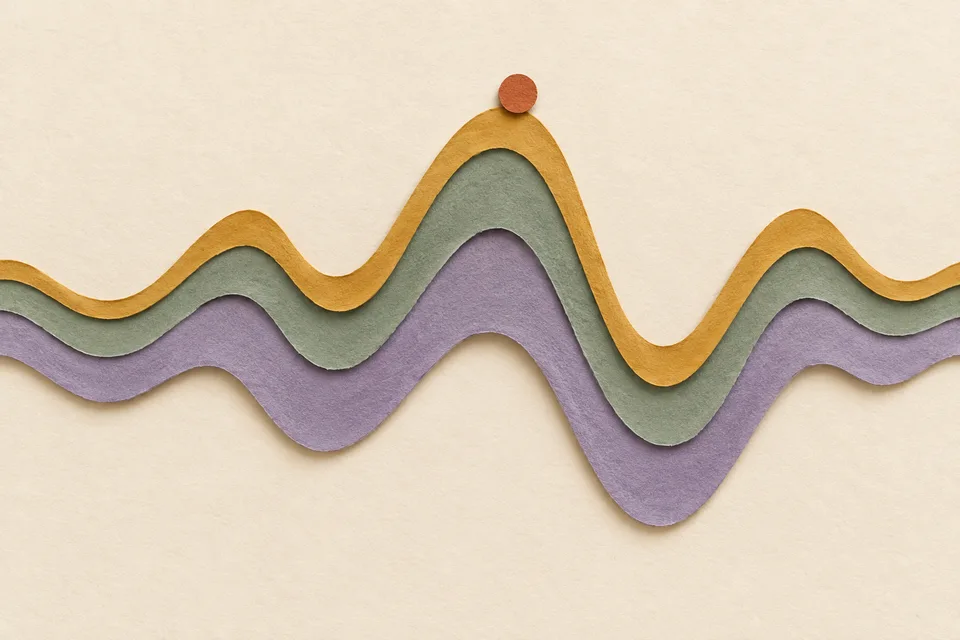
Two people go through the same thing, and one stays calm while the other swings hard. It's not a difference in willpower or maturity; the strength of your natural reactions is simply different. People with a wide emotional amplitude find the color of their mood changing vividly even at small triggers. In return, they feel joy intensely too, show their feelings honestly, and bounce back up quickly once something lifts them, even after sinking.
People with a narrow amplitude have their own difficulties too. Since their feelings don't move much, they sometimes only notice they're exhausted long after the fact, and their muted reactions, even to good news, can get them misunderstood. So there's no need to stand yourself next to an always-calm friend and ask, “They're like that, so why am I like this?” Neither is better; your temperaments are just different.
Why you're fine in the morning and sink in the evening
There's a reason this pattern is especially common. During the day, the you around people does more work than you'd think. You manage your expressions, let irritating comments slide, and keep in step with the mood. If you're high in accommodation, even more so. The feelings that come up in the meantime don't disappear; they're put on hold.
Then, on the way home or the moment you open your front door, the outer you finishes its shift and you return to the inner you. That's when the feelings you put on hold all arrive at once. You're not sinking even though nothing happened; what happened during the day is only now arriving. The farther apart your social self and private self are, the longer this delay. We go into these two sides of you in more detail in What social self and private self mean.
The dip that comes after a fun day works the same way. You've probably had nights after coming home from a blast with friends, or Sunday evenings after getting back from a long-awaited trip, when you actually feel empty and low. The energy you pumped up while you were out comes back down to baseline the moment you're alone. Sinking after a good day doesn't mean the day wasn't fun.
Self-blame is what doubles the swing
A feeling dipping once is one wave. But when “What's wrong with me, I'm so weird” attaches itself right after, a second wave forms. What started as tiredness or hurt becomes disappointment in yourself for feeling that way. The first wave can settle overnight, but the second hardens into the conclusion “This is just the kind of person I am” and sticks around into the next day.
Follow the flow and it goes like this. A friend's reply is short, and you feel a little hurt. Right after comes “How petty of me to be hurt by something like this.” Then comes “Why am I always like this?”, and by the time you fall asleep you can't even remember the hurt, only your disappointment in yourself. The first feeling was small; it grew once a verdict was attached.
Many people who feel their ups and downs are extreme actually have a second wave that's bigger than the first. That's why the quickest way to reduce the swings isn't pushing your feelings down but taking out the self-blame.
Check in with yourself
These are questions for gauging whether your current ups and downs are closer to a personality trait. Please use them only as a way to observe yourself, not as a diagnosis.
- Even when you sink hard, you usually come back to where you were within a few days.
- You swing hard in the good direction too. You feel excitement and joy intensely as well.
- When you look back later, you can roughly guess what set off the swing.
- Even with the ups and downs, the basics of your day, like sleep, meals, and going to work or class, are holding up.
- It's not something that started suddenly; you've been this way for a long time.
What these five sentences look at comes down to three things: whether it's a trait you've always had, whether you have the strength to come back up as much as you sink, and whether it's getting in the way of running your days. When it's a personality trait, these three usually show up together.
If you're nodding along to most of them, it's fine to read your current ups and downs as a wide emotional amplitude. On the other hand, if a few of them give you pause, especially if the fourth sentence feels far from how you've been lately, please be sure to read the section below as well.
Five ways to live with your ups and downs
- Narrate instead of blaming yourself. Instead of “Here I go again,” try saying to yourself, “I'm heading down right now.” Like giving a weather report, leave out the judgment and just state the conditions, and there's less room for a second wave to form. It feels awkward at first, but after a few tries, the words “heading down” themselves create a little distance.
- Put off decisions at the bottom. Decide in advance that on low evenings you won't make big decisions like quitting, breaking up, or making a large purchase. A single rule, “Look at this again tomorrow morning,” is enough. At the bottom, everything looks darker than it really is. The same job and the same relationship look different at ten at night and ten in the morning, not because the facts changed but because the eyes looking at them did.
- Give yourself landing time in the evening. Instead of checking your phone or diving into unfinished tasks the moment you get home, set aside twenty minutes to change clothes and wash up as landing time. You're deliberately making room for the feelings put on hold during the day to arrive. It's even better if you name the feeling that arrives in a word or two. “Ah, I felt kind of wronged in that meeting today.”
- Give the people close to you one sentence ahead of time. “I tend to get a bit quieter in the evenings. It's not because of you, so don't worry about it.” If the other person doesn't misread it, one wave that would have come from the relationship disappears. This sentence is for you, too. Saying it in advance leaves less room for the worry “Did I ruin the mood again?” to creep in.
- Leave a line for your morning self. On a low night, write how you feel right now in one line in your notes app. “Hate everything, sick of everything.” Then read that line again the next morning. When you see for yourself that the same person is looking at the day with different eyes just ten hours later, it becomes easier to believe that next evening's low won't last forever either.
How not to read this
Saying you have a wide emotional amplitude isn't a label calling you an emotional person. But it doesn't mean you should brush off every up and down as “just my temperament,” either. The questions above aren't a test that judges you but a mirror for seeing yourself as you are now a little more accurately. Even if someone tells you, “Your moods are all over the place,” you don't have to take it as a verdict.
If a low mood has lasted for weeks, your sleep or appetite has noticeably changed, or the days feel so heavy that you keep missing things you need to do, it's hard to explain by temperament alone. In that case, talk with a doctor or a counselor. Just as you'd see a doctor when a bad cold drags on, getting help when your heart has felt heavy for a long time is a perfectly natural thing to do.
Not strange, just not known yet
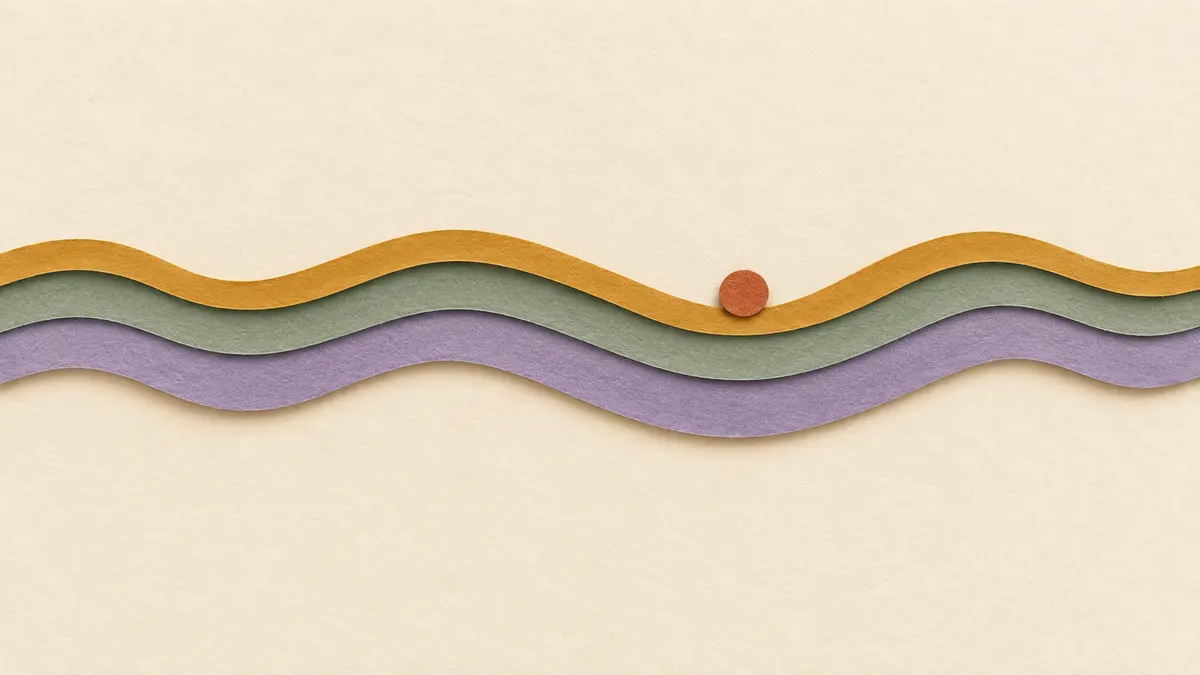
If your moods swing a lot, you're not a strange person; you're closer to someone who hasn't yet learned the full shape of their waves. Just knowing that what you held in during the day arrives in the evening, and that self-blame creates an extra wave, makes the same evening a little less heavy. If you'd like to map when and where your ups and downs get biggest, read A heart with a wide amplitude too. If you look at the you around people and the you alone separately in the free personality test, you can also see how different your emotional amplitude is between those two places.
The “you” in this story, is it really you?
See my Social & Private self · freeFree · Start without sign-up