When It Takes You a Long Time to Adjust to a New Place
You're Not Slow, You're Drawing the Map
Adjusting comes in layers: people, unspoken rules, routines and spaces, and newness itself. We look at the traits that move at different speeds in each layer, and how to get through the first few weeks, when your social self acts settled while your private self is still unpacking, with less exhaustion.
The “you” in this story, is it really you? See my Social & Private self · free →
It's been a month since you changed jobs. You've finally memorized everyone's names on the team, but you're still unsure who it's natural to have lunch with, and whether you can ask questions by message or should walk over to someone's desk. The coworker who started on the same day is already trading jokes with the team. You feel like you barely did anything all day, and yet on the way home you're strangely wiped out. “Am I the only one this slow?”
A new school, a new neighborhood, a new company. Wherever it is, some people take longer than others to settle in. In this piece, let's talk about why adjusting comes at a different pace for everyone, what's actually happening inside a slow adjustment, and how to get through that time with less exhaustion.
Adjusting isn't one thing, it comes in layers
Inside the words “I've settled in” are several different layers. Knowing where things are and in what order things get done. Knowing who's close to whom and whom to ask about what. Knowing the rules nobody tells you, like the tone people use and the general atmosphere. And even your body getting used to a new commute and a new bedtime. In a new neighborhood, these layers include where to shop for groceries and which bus routes to take; at a new school, how classes are run and the vibe of your class.
Everyone learns these layers at a different speed. And what people usually call “adjusting fast” is mostly the most visible layer: getting close to people quickly. Someone who carefully learns the other layers first doesn't show it on the outside for a while, so it's easy for them to look slow.
Traits that move at different speeds in each layer
| Layer of adjusting | Traits that get used to it fairly quickly | Traits that take longer | What helps |
|---|---|---|---|
| People | High on Social | Low on Social | Getting close to one person first |
| Unspoken rules | A narrow emotional amplitude | High on Accommodating, or a wide emotional amplitude | Picking someone you can ask easily |
| Routines and spaces | Low on Organized | High on Organized | A notebook of your own for sorting things out |
| Newness itself | High on Inquisitive | Low on Inquisitive | Keeping one familiar habit |
The place to look in this table is Organized. People high on Organized need to see the whole picture before they can relax, so until the map is complete, every single step feels uneasy. People low on Organized, on the other hand, figure things out as they bump into them, so at first they seem to struggle less. But once the map is complete, people high on Organized settle in more steadily than anyone. In many cases, slow adjusting is adjusting that draws the map first.
People high on Accommodating or with a wide emotional amplitude linger in the layer of unspoken rules. How loudly are you supposed to talk here? Is it okay to laugh at this joke? They check each thing one by one, so their mind never gets a break. People low on Social take their time with the people layer. It's hard for them to speak up when a lot of people are gathered, but once they get comfortable with one person, that relationship doesn't shake easily. For people low on Inquisitive, newness itself has a cost. A day with nothing familiar in it uses up a lot of energy all on its own. People high on Inquisitive feel excited at first, but they may wobble once more around the time the newness wears off and the routine sets in.
Your social self acts settled, your private self is still unpacking
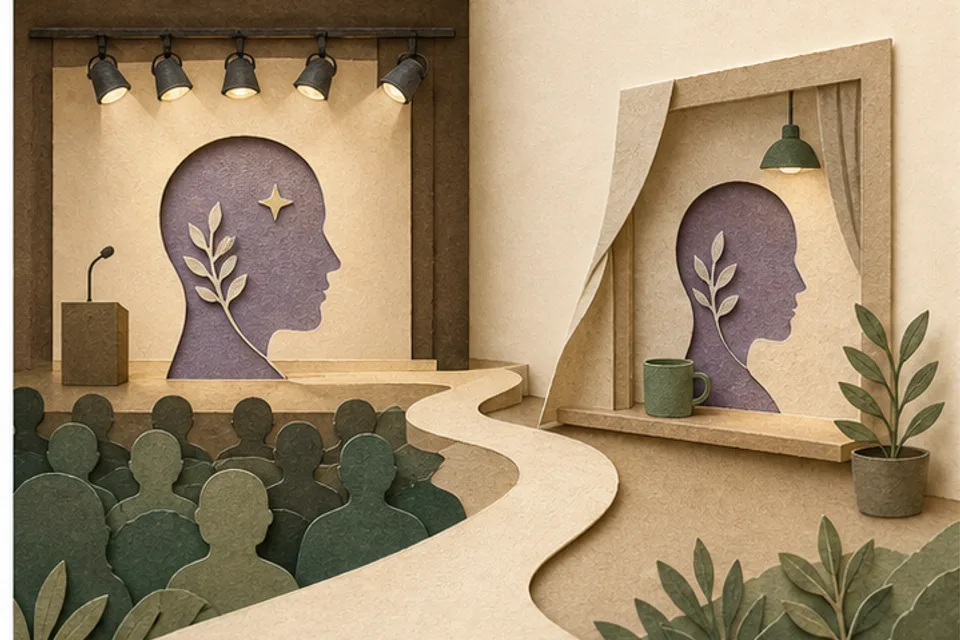
In a new place, the you around people is switched on bigger than usual. You remember names, say hello first, and smile like everything's fine. Meanwhile, the you when alone is still sitting among the moving boxes, sorting through, one by one, what you heard today, what confused you, and the moments you think you messed up.
That wiped-out feeling on the way home comes from here. You're not tired because you did nothing. You're tired because your social self was on all day while, inside, you never stopped unpacking. With both places working at the same time, of course you're exhausted. If you're low on Social, it takes more energy to keep your social self switched on, so the fatigue of the first few weeks feels even bigger. This fatigue isn't a sign that you're failing to adjust. It's a trace showing that adjusting is underway.
How a slow adjustment usually unfolds
From the outside, a slow adjuster's time looks like standing still. But inside, things happen in order. At first, you mostly watch. Who talks in what tone, how meetings flow, how lunch gets decided. You quietly gather it all. Next, you get a little comfortable with one or two people, and you start to see the line between what you can ask about and what you're expected to figure out yourself. And then one day, out of nowhere, you notice you're walking without asking for directions.
In this process, comparing yourself to the coworker who started on the same day just keeps making you impatient. People who get close to others first are quick at the start, and people who draw the map first are solid later on. The speed is different, but where you both end up isn't that different.
Five ways to get through the adjusting period with less exhaustion
- Set some fixed points first. Decide on a few things you don't have to think about, like the same seat, the same route to lunch, the same coffee. On a day full of new things, having even one less decision to make frees up room in your head. In a new neighborhood, one go-to shop can be that fixed point; at a new school, a seat you always take.
- Pick one person you can ask easily. “What confused you the most when you first started here?” That one question teaches you some of the unspoken rules and opens the door to a conversation. Everyone was new once, so most people are happy to answer. If you're not sure whether it's okay to ask by message, you can ask that first: “Is it usually okay to ask about things like this by message?”
- Get close to one person before a group. If you're low on Social, coffee with one person is much easier than a group lunch. “Want to grab coffee next week?” Once you're comfortable with one person, you'll connect with others through them.
- Schedule recovery time after work. While you're adjusting, cut back a little on evening plans and big commitments. Leaving one weekend day completely unplanned helps too. The you when alone needs time to unpack so you can switch your social self back on the next day.
- Write down what you learned this week. Every Friday, write three lines about things you didn't know last week but know this week. The slower someone adjusts, the smaller they tend to see their own progress. Once you write it down, you'll see you've come farther than you thought.
If reading the atmosphere in a new place wears you out in particular, we talked about that fatigue separately in I Read the Room Too Much.
Don't read it this way
- Adjusting slowly doesn't mean you don't fit the place. Many people who settle in slowly end up staying long and putting down deep roots.
- Adjusting fast isn't better, either. Fast adjusting and slow adjusting each miss some things and gain others.
- It doesn't mean you should show up to every gathering to adjust faster. If you spend all your energy, your private self won't have time to unpack, and adjusting can actually take longer.
- That said, if a good amount of time has passed and you can barely sleep, dread leaving home every morning, or feel like your body and mind keep falling apart, it may not be a matter of speed. In that case, don't try to push through alone; talk to a professional.
Wrapping up
People who take a long time to adjust aren't slow. They're carefully learning layer after layer. Even if it doesn't show on the outside, inside, the map is being drawn one sheet at a time. The day it's finished usually arrives quietly, all of a sudden. If you're wiped out on the way home today, it means you took in that much during the day.
If you're curious how the you at work differs from your usual self, you might also read Why Is the Me at Work Different From My Usual Self?. The free personality test shows the you around people and the you when alone on five personality traits, separately. Seeing where you land on Organized and Social in each of those two situations shows which layer you tend to linger in.
This piece is meant to help you understand yourself and does not replace psychological diagnosis or treatment.
The “you” in this story, is it really you?
See my Social & Private self · freeFree · Start without sign-up