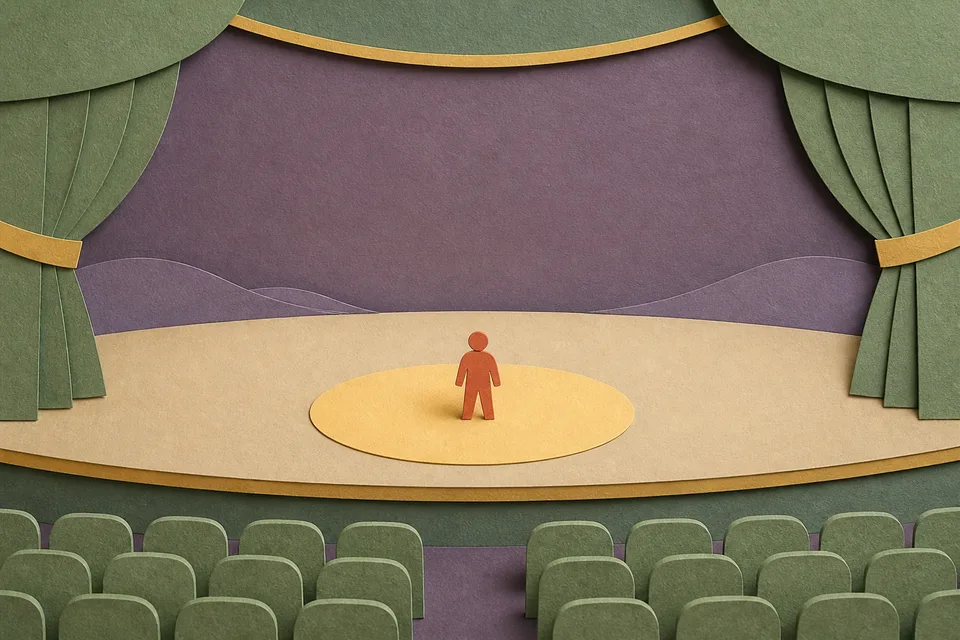
I Read the Room Too Much
Reading the Room Isn't a Weakness, It's a High-Performance Antenna
Do you read the mood first and sense someone's feelings in half a second? Reading the room isn't dullness, it's a sensitive antenna that catches even the faintest signals.
The “you” in this story, is it really you? See my Social & Private self · free →
When I'm with people, I find myself scanning the mood without meaning to. Who's in a bad mood, whether what I said was okay, whether it's all right to jump in right now. And as I do, my own feelings get pushed to the back, and I come home and wear myself out chewing over “was that remark earlier a mistake?” I end up blaming myself with “why do I read the room so much?” But reading the room isn't a weakness. It's a high-performance antenna that picks up even signals others can't read. In this article I'll unpack the true nature of reading the room, and how not to be ruled by that ability.
Reading the room isn't a weakness, it's a “social antenna”
Being quick to read the room means you detect social signals with precision. The subtle shifts in an expression, the temperature of a tone of voice, even the grain of a silence: you take in information others just walk past.
- You read the mood fast and adapt well to the situation.
- You sense what someone needs even when they don't say it.
- You pick up on a brewing conflict early and smooth it out.
This is a sign of high empathy and a delicate touch with relationships. People who can't read the room may have it easy, but they don't have this kind of sensitivity. So feel free to reread “reads the room” as “deeply considerate.”
So why does reading the room wear me out?
The problem is when the antenna is turned up too high. The more signals you take in, the greater the drain.
- You feel others' moods as if they're your responsibility, so when the mood is off, it feels like your fault.
- You tend to the other person's reaction before your own needs, and end up losing yourself.
- You keep chewing over a finished conversation, censoring yourself with “was that remark okay?”
This isn't that reading the room is bad, it's that the antenna's volume control isn't working. Once you know how to turn it on and off, the same ability wears you out far less.
How to adjust the antenna's volume
- Separate others' moods from your responsibility: Just because someone's in a bad mood doesn't mean it's all your fault. Try stepping back with “that person's mood is their own.”
- Read your own needs as signals too: Don't read only others' signals, tend to “what do I want right now?” too. Turn the antenna of room-reading toward yourself as well.
- Stop the chewing-over: Censoring a finished conversation means the antenna is overheating. Lower the switch with “that's already over and done.”
- Allow yourself to not please everyone: You can't make everyone comfortable. Sometimes holding your own standard is better than losing yourself trying to fit everyone.
Start by getting to know your grain
What makes reading the room hard is the helplessness of “why do I care this much?” When you know how sensitive your grain is to social signals and where you put others first, you can use that ability on your side instead of blaming yourself. Reading the room isn't about turning it off, it's about adjusting the volume.
Meet your personality (social self and private self) first with a free personality test. You'll see in the results that the “room-reading me” was really “the me who reads things with a delicate touch.”
This article is meant to help with self-understanding and is not a substitute for psychological diagnosis.
Good reads to go with this
The “you” in this story, is it really you?
See my Social & Private self · freeFree · Start without sign-up