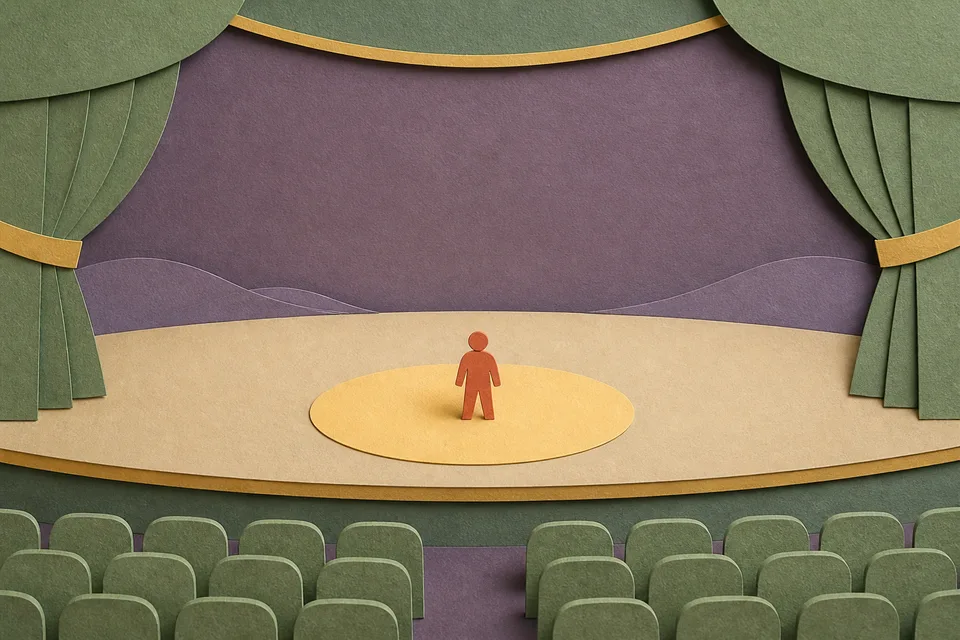
I Get Especially Nervous in Front of People
The Real Reason Behind Stage Nerves
Do you talk easily with friends, yet your voice shakes the moment you have to present? The shaking isn't timidity; it's that when all eyes turn to you, your attention swings away from what you're saying and onto yourself.
The “you” in this story, is it really you? See my Social & Private self · free →
It's the part of the meeting where everyone takes a turn saying something. From about three people before your turn, your heart starts racing. You don't take in a word of what the people before you are saying; you just keep revising what you'll say in your head. Finally it's your turn. The moment you open your mouth your voice wobbles a little, and half the sentences you prepared fly out of your head. You can only breathe again once you've sat down, and that night you replay those 30 seconds over and over.
What's strange is the you who's with friends. When you're chatting, the words flow easily, and at gatherings you're even the one who livens up the mood. So why do you turn into a completely different person the moment it's called a presentation? In this piece, we'll look at where that difference comes from and how to bring the nerves along with you instead of trying to get rid of them.
You shake because you want to do well
You don't get nervous in situations you don't care about. The shaking is your body's signal that says, “This is an important moment.” A racing heart and sweaty palms aren't a malfunction; they're your body gathering its strength ahead of something important. That's also why your body reacts in a similar way when you're excited and when you're nervous.
So getting shaky before a presentation doesn't make you a timid person. If anything, it's closer to meaning you have a strong desire to do well and not to let the people listening down.
Think back to the time you were most nervous and this becomes even clearer. Sometimes one team lead is more nerve-racking than a hundred strangers, and coworkers you sort of know are more nerve-racking than people you've never met. The more the judgment in that setting matters to you, the bigger your body's reaction. The size of the nerves shows how much you care about that moment.
When all eyes turn to you, your attention turns to yourself
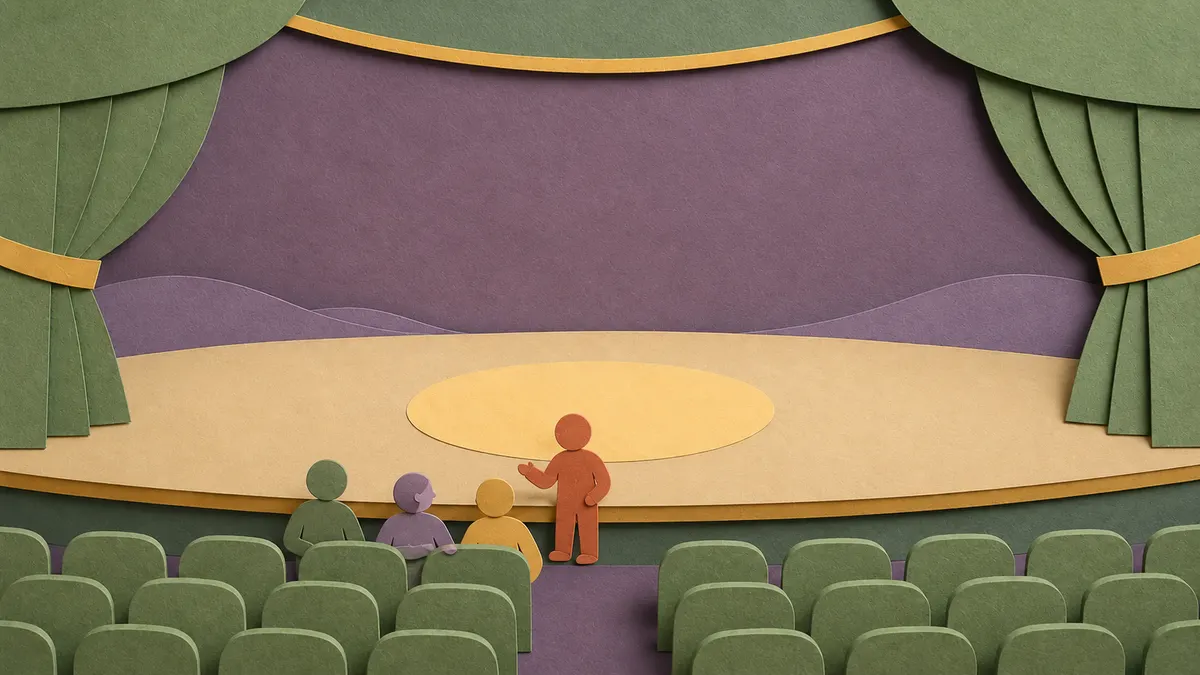
But what really throws a presentation off is less the shaking in your body than the direction of your attention. When you're talking with a friend, your attention is on them and on the conversation. But when lots of people look at you at once, your attention whips around and points at you. “Is my voice shaking right now?” “Does my face look weird?” “Did I just trip over my words?”
At that moment there are two people in your head: the you who's talking, and the you grading that person from the outside. The more energy the grader uses, the less the speaker has left. The sentences you prepared don't fly away because you're not smart enough; it's that the grader is taking up too much room.
On top of that, the grader always exaggerates. From the inside your voice may sound like it's shaking badly, but from where the listeners sit, it's usually less noticeable than you think. Only you can hear your own heartbeat. And the listeners are usually busy worrying about their own turn, just like you, who didn't hear a word from the people before you while waiting for yours. Those 30 seconds you rewind all night, other people forget much sooner than you'd think.
Why chatting is fine but presenting makes you shake
The same person shakes differently depending on the setting because the structure of the setting is different.
| Structure of the setting | Chatting with friends | Presenting or speaking up in a meeting |
|---|---|---|
| Flow of talk | You go back and forth | You have to carry it alone to the end |
| When you slip up | You laugh it off | It feels like it hangs there, with everyone having heard it |
| Evaluation | Almost none | It feels like both your content and your manner are being judged |
| Eyes | Scattered in all directions | Gathered on one person |
People high in sociability can absolutely get nervous before a presentation too. Liking people and being evaluated alone are two different things. The you in a comfortable setting and the you in front of people moving differently isn't pretense but natural adaptation. We go into this in more detail in A different me pops out with different people.
The hardest point differs by temperament too. People high in accommodation find the time before presenting hardest, afraid of disappointing the listeners, while people with a wide emotional amplitude find the time after harder, because the tension that rose lingers long after it's over. If you're someone who rewinds those 30 seconds that night, you're probably closer to the latter.
Why memorizing a script makes you shakier
People who get nervous usually prepare more. They memorize the talk word for word and even write out answers to expected questions in full sentences. But there's a trap in this approach. Once you've memorized every sentence, getting stuck on a single word becomes a signal that you've gone wrong, and in that moment the grader wakes up again. The more you prepare this way, the more places there are to go wrong.
So it's better to prepare a skeleton rather than sentences. Split what you want to get across into three chunks, and memorize just the first sentence of each. The only parts worth memorizing whole are the opening and closing mentioned below. And keep two or so emergency-exit sentences ready for when you get stuck. “One moment, let me check my notes.” “That's a good question. Let me look into that and get back to you.” Knowing there's a way out even if you get stuck makes the grader's voice a lot quieter.
Five ways to bring the nerves along
- Memorize the first 30 seconds whole. The nerves are strongest at the start. Get “Hello, today I'll share just three things. The first is” down until it rolls off your tongue, and you'll pass automatically through the shakiest stretch. Decide on a closing line too. “That's everything from me. Thank you for listening.” When the ending is set, you're also less likely to ramble and lose your way.
- Decide in advance who you'll make eye contact with. Find two or three people who nod along easily and speak as if you're talking to them. Changing the structure from facing a whole audience to talking with a few people turns your attention back outward. In a video meeting, hiding your own face on the screen is another option. When you can keep seeing your own face, the grader gets even busier.
- Make your exhale longer than your inhale. While you wait for your turn, breathe in for a count of four and out for a count of six. Calming your body first works faster than calming your mind. Long exhales bring your raised shoulders down and your voice lower. Even three rounds in the hallway or the restroom right before you present make a difference.
- Admit the nerves in a single sentence. “I'm a little nervous. I'll take it slowly.” Once you stop spending energy on hiding it, your voice can actually steady. Listeners usually become more forgiving, too.
- Afterward, write three lines instead of rewinding. One thing that went well, one thing to change next time, and one line about what anyone actually said. As you write the third line, you can see the gap between the reaction you imagined and the real one. Most of the time it was a single “Thanks, that was helpful,” or nothing at all. As those notes pile up, the imagined scenes the grader pulls out before your next presentation slowly lose their power.
How not to read this
Getting shaky before a presentation doesn't mean you're bad at working life or not cut out to be in front of people. Plenty of people shake and still say what they came to say. The goal isn't to stop shaking but to get your message across while shaking. How quickly the nerves ease differs from person to person, too. Some people get comfortable after a few tries, and some always shake a little every time. Both are fine.
That said, if fear of presenting or of gatherings keeps you avoiding classes, meetings, or chances to see people, or you lose sleep and feel sick to your stomach for days beforehand, you don't have to push through it alone. Talking with a doctor or a counselor can help you find an approach that works for you.
The shaky you is the you who wants to do well
Nerves are less an enemy to eliminate and more a companion you bring along. Turn the grader's voice down a little and point your attention back toward the listeners, and even if the shaking stays, your words still get through. The next time your heart races before a presentation, try remembering, just once, that it means you care about that moment. If your drive to do well is so strong that your preparation never feels finished, Perfectionism, strength or shackle? may help too. If you look at the you around people and the you alone separately in the free personality test, it'll become a little clearer in which settings you especially freeze up, and whether the root is accommodation or emotional amplitude.
The “you” in this story, is it really you?
See my Social & Private self · freeFree · Start without sign-up